Boltz and Kiin Bio Partner to Power the Next Generation of AI-Driven Drug Discovery
We are excited to announce a new partnership between Boltz and Kiin Bio, to accelerate how drug discovery teams reason about and design therapeutics.
Why we're partnering
Over the past year, the Boltz team has developed a family of state-of-the-art open-source biomolecular models, including Boltz-2 and BoltzGen, covering protein folding, co-folding, binding, and generative design. With the recent raise, the Boltz team have improved their existing models and also released their small molecule design and protein design pipeline.
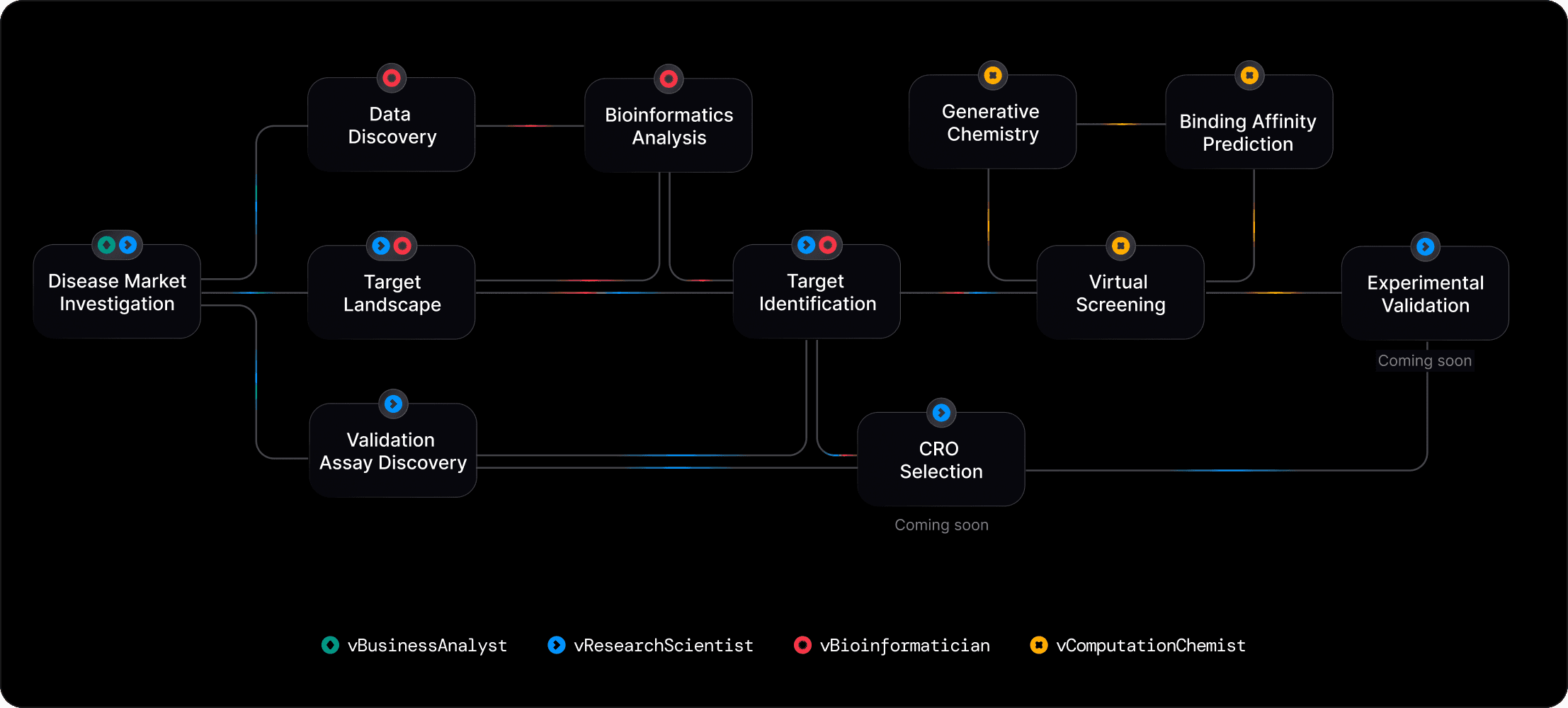
All these models and agents are part of a bigger value chain, with upstream work (commercial intelligence, target ID and bioinformatics, …) and downstream work (e.g. lab validation). Today, these steps remain disconnected, and that’s where Kiin Bio comes in.
Kiin Bio developed KiinOS, a single platform that can execute any scientific experiment, from commercial intelligence and target ID to computational chemistry, and where every result, hypothesis, and decision in a drug programme is captured, connected, and distilled into a key signal of what to do next.
What the partnership includes
Through this deeper partnership and integration with the Boltz API, researchers will be able within KiinOS to execute and connect insights across the entire pre-clinical phase, going from Target ID to a fully designed drug in a single platform.
In practice
As a practical example, a client recently started a new programme for idiopathic pulmonary fibrosis (IPF) in the platform. In KiinOS, the scientists identified the right commercial opportunity and targets by mining the commercial and scientific landscape, including literature, patents and competitive intelligence data. They then validate the chosen target's biology by interrogating large scale and perturbation data and scRNA data (e.g. CELLxGENE), building mechanistic and biological confidence. With the validated target in hand, users leveraged Boltz’s small-molecule design pipeline (via our API integration) to generate novel compounds directly against the target's binding pocket, constrained to ENAMINE REAL building blocks so every design was synthetically tractable and automatically rejecting anything with a known structural concern. The most promising molecules were screened via ADMET’s recent Boltz model and the most promising designs are now being tested in the lab, closing the loop from literature to bench inside a single platform. Next step: designing proteins with BoltzGen to explore how diverse modalities can help IPF’s drug effort!
We’ve been incredibly impressed by the pace of development at Boltz, not only in optimising their existing models, but also in delivering new capabilities such as small-molecule design and large-scale library screening. We’re excited to bring these advances into KiinOS workflows and to continue building closely with Gabriele and the Boltz team.
— Filippo Abbondanza, Founder
Biotech and pharma organisations still struggle to connect the many activities carried out across the drug discovery process. That’s exactly the problem Kiin Bio is solving with KiinOS, and why this partnership was important to us. We’re looking forward to working closely with the Kiin Bio team and their customers to enable more integrated, AI-native discovery.
— Jeremy Wohlwend, Co-Founder
About Boltz
Boltz is an AI company building open, state-of-the-art foundation models for biomolecular structure prediction, binding affinity estimation, and generative therapeutic design. As a public-benefit company, Boltz is focused on making advanced AI for biology more accessible, transparent, and usable across drug discovery. Learn more at https://boltz.bio